
Nic salt vs freebase is the single most common point of confusion when buying e-liquid, and getting it wrong is why a device that should work perfectly ends up feeling harsh, weak, or sickening.
They are not flavour options or quality grades. They are two chemical forms of the same nicotine, each matched to a different type of device.
On this page
- The one-line answer
- What freebase nicotine is
- What nicotine salt is
- Nic salt vs freebase in the wrong device
- How to identify your device
- Choosing your strength
- Frequently asked questions
Here is how to tell which one you need, in under five minutes.
The one-line answer
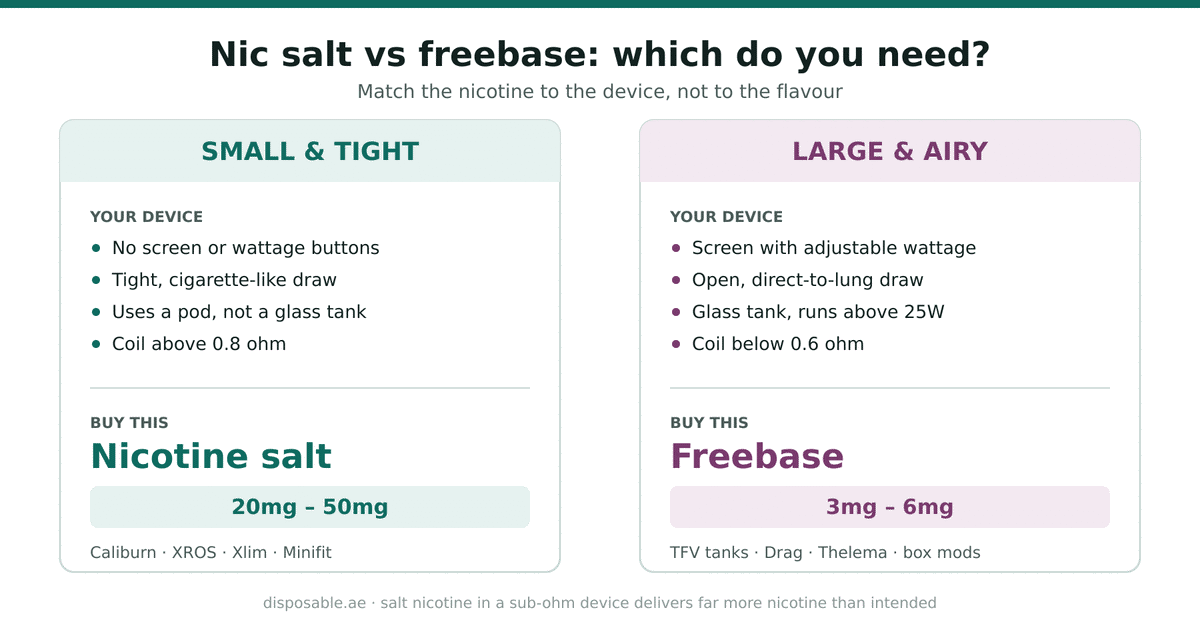
If your device is small, tight to draw on, and has no screen or wattage buttons, you want nicotine salt at 20mg or higher.
If your device is larger, produces big clouds, and lets you set the wattage, you want freebase at 3mg or 6mg.
If that already answered your question, you can stop reading and go to our e-juice range. If you want to understand why, keep going.
What freebase nicotine is
Freebase is the original form used in e-liquid, and it is the same form delivered by a cigarette. It is chemically the unprotonated version, absorbed efficiently, but it is alkaline — and that alkalinity is what makes it harsh on the throat as strength rises.
At 3mg it is smooth. At 12mg most people find it uncomfortable. At 20mg it is genuinely difficult to inhale. That harshness places a practical ceiling on how strong freebase can usefully be.
This is fine for a sub-ohm device, because those produce a very large volume of vapour per puff. Even at 3mg, the total nicotine you take in per draw is substantial simply because there is so much vapour carrying it.
What nicotine salt is
Nicotine salt is the same nicotine molecule with an acid added, most commonly benzoic acid. That lowers the pH of the liquid and converts the nicotine from its alkaline freebase form into a protonated salt, which removes most of the throat harshness.
This is not marketing. A published analysis of 23 commercial refill liquids confirmed benzoic acid as the dominant acid used, and clinical pharmacokinetic work comparing cigarettes with nicotine-salt e-cigarettes found salt formulations produce a blood-nicotine curve considerably closer to a cigarette than earlier freebase products managed.
The practical result is that 20mg or 50mg salt nicotine goes down smoothly where the equivalent freebase would be unvapeable. It also absorbs quickly, which produces a faster satisfaction curve much closer to what a cigarette delivers.
That combination is why salt nicotine transformed switching from smoking. A small, discreet, inexpensive device can now deliver a properly satisfying hit, which previously required a large sub-ohm setup.
Nic salt vs freebase in the wrong device
Salt nicotine in a sub-ohm device
This is the dangerous mistake of the two. A sub-ohm device produces perhaps ten times the vapour of a small pod. Fill it with 50mg salt and every puff delivers an enormous amount of nicotine.
The result is dizziness, nausea, headache, racing heart and sweating. It is not harmful in a lasting sense for most people, but it is genuinely horrible and it can be frightening the first time.
Never put high-strength salt nicotine in a device that produces large clouds. If you can barely see through your own vapour, you are in freebase territory.
Low-strength freebase in a small pod
Less dangerous, more insidious. A small pod at 3mg delivers so little nicotine per puff that you will never feel satisfied. So you vape constantly, still crave a cigarette, and eventually conclude that vaping does not work for you.
It was the liquid, not the concept. This is the quiet reason a great many switching attempts fail.
How to identify your device
If you are unsure which category you are in, check these:
You need nicotine salt if
- The device is roughly the size of a USB stick or a small pen
- There are no buttons, or one button and no screen
- The draw is tight, similar to a cigarette
- It uses a pod rather than a tank with a glass window
- Coil resistance is above roughly 0.8 ohm
Typical devices: Uwell Caliburn, Vaporesso XROS, OXVA Xlim, Justfog Minifit, and most pod systems.
You need freebase if
- The device has a screen and adjustable wattage
- It runs above roughly 25 watts
- The draw is open and airy, straight to the lungs
- It uses a tank with a glass section
- Coil resistance is below roughly 0.6 ohm
Typical devices: SMOK TFV tanks, Voopoo Drag, Lost Vape Thelema, and most box mods.
The middle ground
Some modern devices sit between the two, such as pod mods with adjustable airflow and swappable coils. On these, follow the coil rather than the device. Above 0.8 ohm with airflow closed, use salt. Below 0.6 ohm with airflow open, use low-strength freebase.
Choosing your strength
Once you know which type, strength depends on how much you smoked.
Nicotine salt
- 20mg — light smokers, up to around 10 a day, or anyone who has already cut down
- 50mg — heavier smokers, a pack a day or more
Freebase
- 3mg — the standard for sub-ohm devices
- 6mg — heavier smokers using a lower-powered sub-ohm setup
The most useful signal is your own behaviour. If you are vaping constantly and still want a cigarette, your strength is too low. If you feel lightheaded or slightly queasy, it is too high. Adjust in one step, not two.
What about disposables?
Almost every disposable vape uses nicotine salt, and the decision is already made for you. That is precisely why disposables work so well for people leaving cigarettes: the manufacturer has matched the nicotine type, strength, coil and airflow to each other.
It is also why moving from a disposable to your first refillable device sometimes disappoints. If you buy a pod system and fill it with 3mg freebase because it was cheaper, it will feel like nothing. Match the salt strength you were used to.
Does one taste better?
Neither is inherently better, but they express flavour differently.
Freebase in a sub-ohm device gives volume and intensity. Dessert, cream and bakery profiles have room to develop, which is why brands like Ripe Vapes and VGOD built their reputations there.
Salt nicotine in a tight pod gives precision and clarity. Fruit, menthol and ice profiles are sharper and cleaner, which is why brands like Pod Salt and Nasty focus there.
Frequently asked questions
Can I mix nic salt and freebase in the same tank?
Technically yes, practically no. You end up with an unpredictable strength in a device designed for one or the other. There is no benefit.
Is nicotine salt more addictive?
It is absorbed faster, which makes it more satisfying and therefore easier to use more of. The nicotine itself is identical. For a smoker switching over, that faster absorption is the point.
Why is salt nicotine sold at much higher numbers?
Because it can be. The acid removes the harshness that caps freebase strength, so 50mg is comfortable where 50mg freebase would be unvapeable.
Which lasts longer?
Salt nicotine in a small pod, by a wide margin. A 30ml bottle can last weeks, where a sub-ohm device can consume that in days. Running cost is one of the strongest arguments for a small pod system.
I switched from a disposable and it feels weak. What went wrong?
You are almost certainly on too low a strength, or on freebase when you need salt. Check the bottle.
Why does my vape taste burnt after changing liquid?
Thicker high-VG freebase liquids wick more slowly than thin salt liquids, so a device that coped fine before may now be running the wick dry. See our guide to why a vape tastes burnt.
Still not sure?
Tell us what device you have and how much you used to smoke, and we will tell you exactly what to buy. Message us on WhatsApp or browse our full e-juice range, where every listing states whether it is salt or freebase. Delivered across all seven emirates.
About the author
Ismail Hossain is the founder of Disposable AE and reviews every product guide on this site. He has spent years advising UAE customers on matching nicotine strength to device, which is the question behind most disappointing first purchases. Not sure what you need? Tell us your device and we will point you to the right bottle.
For adults aged 18 and over. This guide covers product selection, not health advice. For independent information on nicotine and quitting smoking, see the NHS guidance on e-cigarettes.